Designing Trust: How Conversational UX Fixed Lvlup's Activation Problem
Sep 2, 2025
Lvlup, Kalido
Users wouldn't upload their CVs to an unknown AI platform. I redesigned the freemium flow around trust-building and improved the activation significantly.
We Built an AI Career Tool. Users Didn't Trust Us.
So we stopped asking for trust and started earning it.
Lvlup uses AI to analyze careers and provide personalized insights through a report.
The process to generate a Lvlup report goes as follows:
Upload your CV (or import from LinkedIn/build from scratch) → Preview & verify your data → Set preferences (location, target role, career goals) → Generate your personalized career intelligence report
But there was a problem:
Users wouldn't upload their CVs to an unknown platform. Our freemium activation was broken.
My Role:
Led end-to-end design for freemium activation strategy through a rapid 1-month iteration cycle. Worked cross-functionally with PM, engineering, and ML teams to design, test, and validate the solution.
Team:
1 Designer, 1 ML Engineer, 1 Full-Stack Developer
Timeline:
1-month rapid iteration cycle
This case study focuses on solving the activation problem. For the full end-to-end product design story—including how we designed the report modules and iterated from V1 to V2—see Transforming CVs into Career Intelligence →
What we tried first
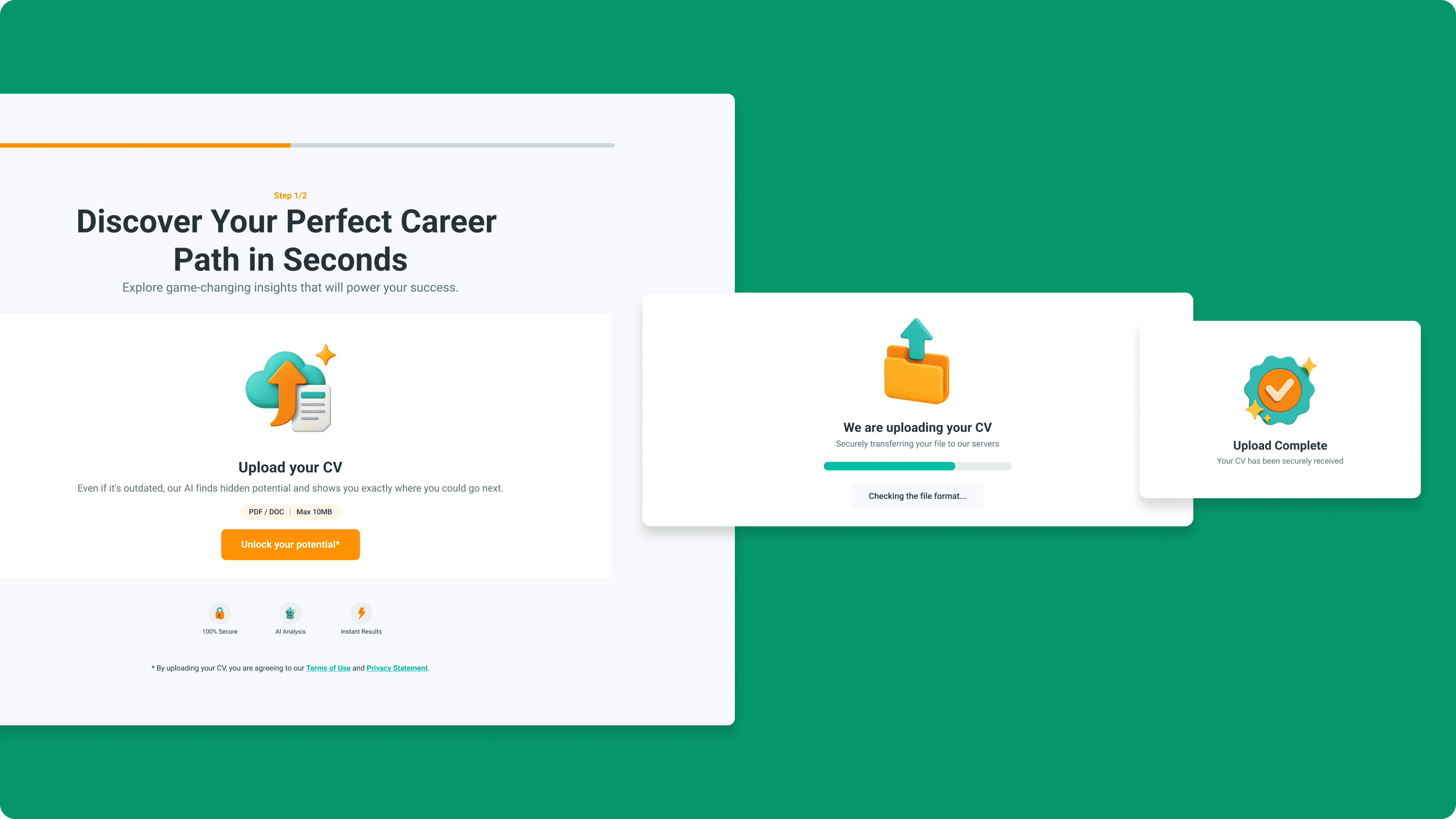
The straightforward approach: Upload your CV, get your free report.
We designed what seemed like a logical freemium flow:
Users upload their CV, our AI analyzes it, they receive personalized career insights for free.
Why we thought this would work:
The CV is our data source: Everything Lvlup analyzes comes from the CV. No CV = no personalized insights.
Clear value proposition: "Upload CV → Get Free Career Report" is direct. Users understand the exchange.
Industry standard pattern : CV uploads are familiar across job platforms and career tools.
Efficient for our AI: More complete data = better analysis.
So asking for it upfront seemed obvious. If the CV is essential to deliver value, why not request it first?
The Problem
Users saw "Upload Your CV" and left
Lvlup needed user data extracted from a CV to generate personalized AI insights. But CVs are personal, sensitive, career-defining documents. We were asking strangers to hand over their professional identity to an unfamiliar AI platform.
The psychological barrier we underestimated:
"Why does this new AI tool need my entire career history?"
"What if this data gets misused?"
"I don't know if this platform is credible yet."
"This feels like a big commitment for something I haven't seen work."
The consequences:
High drop-off at the upload step
Low freemium completion rates
Users never experienced Lvlup's value
Growth stalled before we could prove what we built
We were asking for trust before we'd earned it.
The Insight
I realized we had the problem backwards. We were asking users to commit before we'd proven our value. The upload-first approach assumed trust we hadn't built yet.
The insight came from empathy
I wouldn't hand my CV to a stranger either. Not without proof they understood me first.
The psychological shift we needed:
Users don't need to trust us immediately but they need to see we get them before they share sensitive data. Show competence first, then ask for commitment.
The Solution
Conversational UX
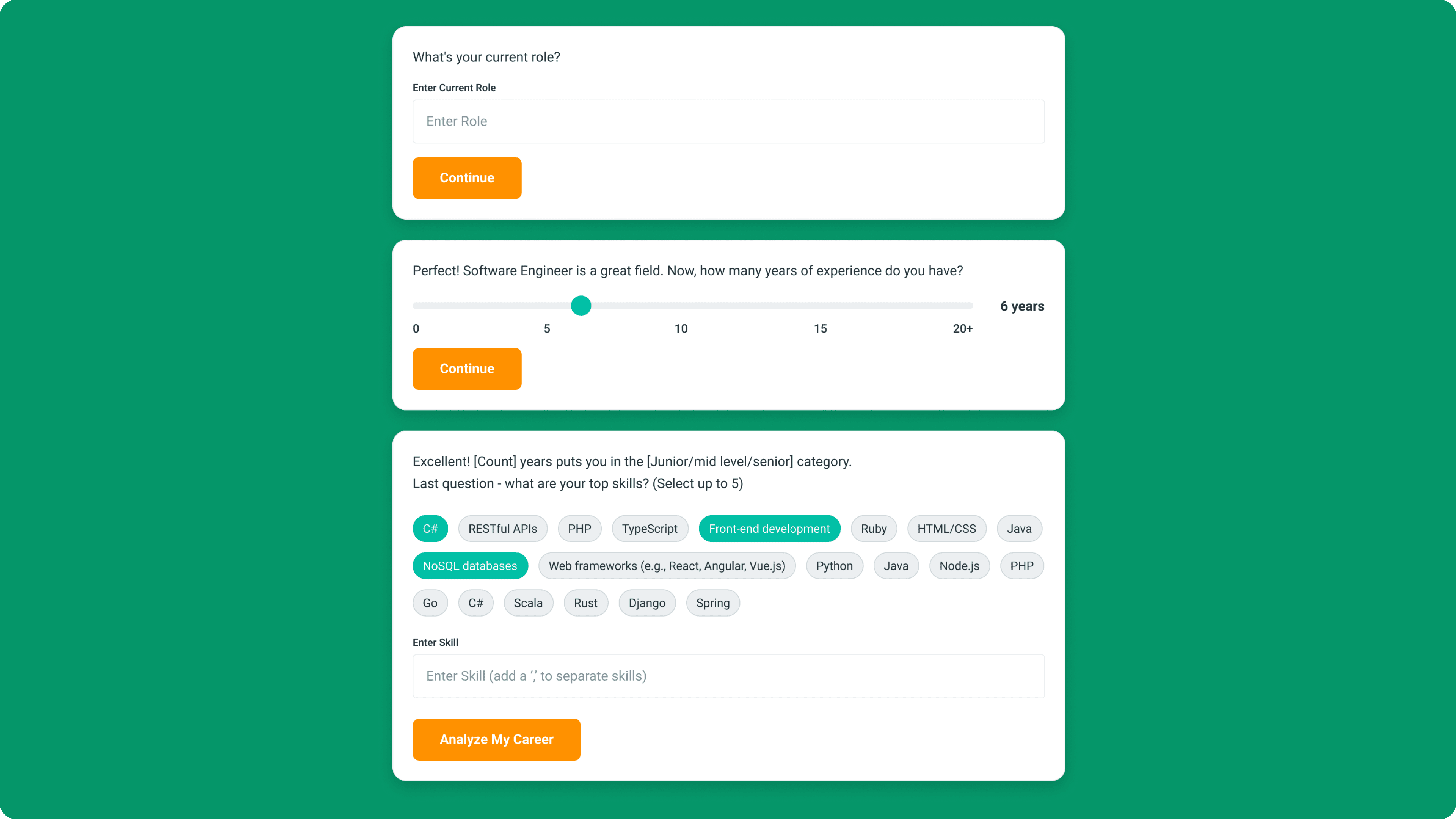
3 questions to prove we understand you.
The conversational flow needed to accomplish two things simultaneously: gather enough data for meaningful AI analysis, while keeping the commitment low enough that users wouldn't hesitate.
The 3 questions we chose:
What's your current role? (establishes career context)
How many years of experience do you have? (determines career stage)
What are your top skills? (provides specific analysis points)
Why these specific questions:
Takes under 2 minutes to answer
Feels anonymous enough to share freely (no personal identifiers, no CV upload)
Gives our AI sufficient signal to generate personalized insights
Each answer builds context for the next—conversational progression, not interrogation
Why conversational UX?
Aligned with AI/LLM interaction patterns users were becoming comfortable with
Feels collaborative, not extractive—questions feel like dialogue, forms feel like data collection
Reduces perceived risk—answering questions feels lower-stakes than uploading documents
Building Trust
The Preview
Show them we understand them, before asking for more.
After users answer the 3 questions, the AI generates a personalized career preview. This is the critical moment where we either pass or fail the "specificity test."
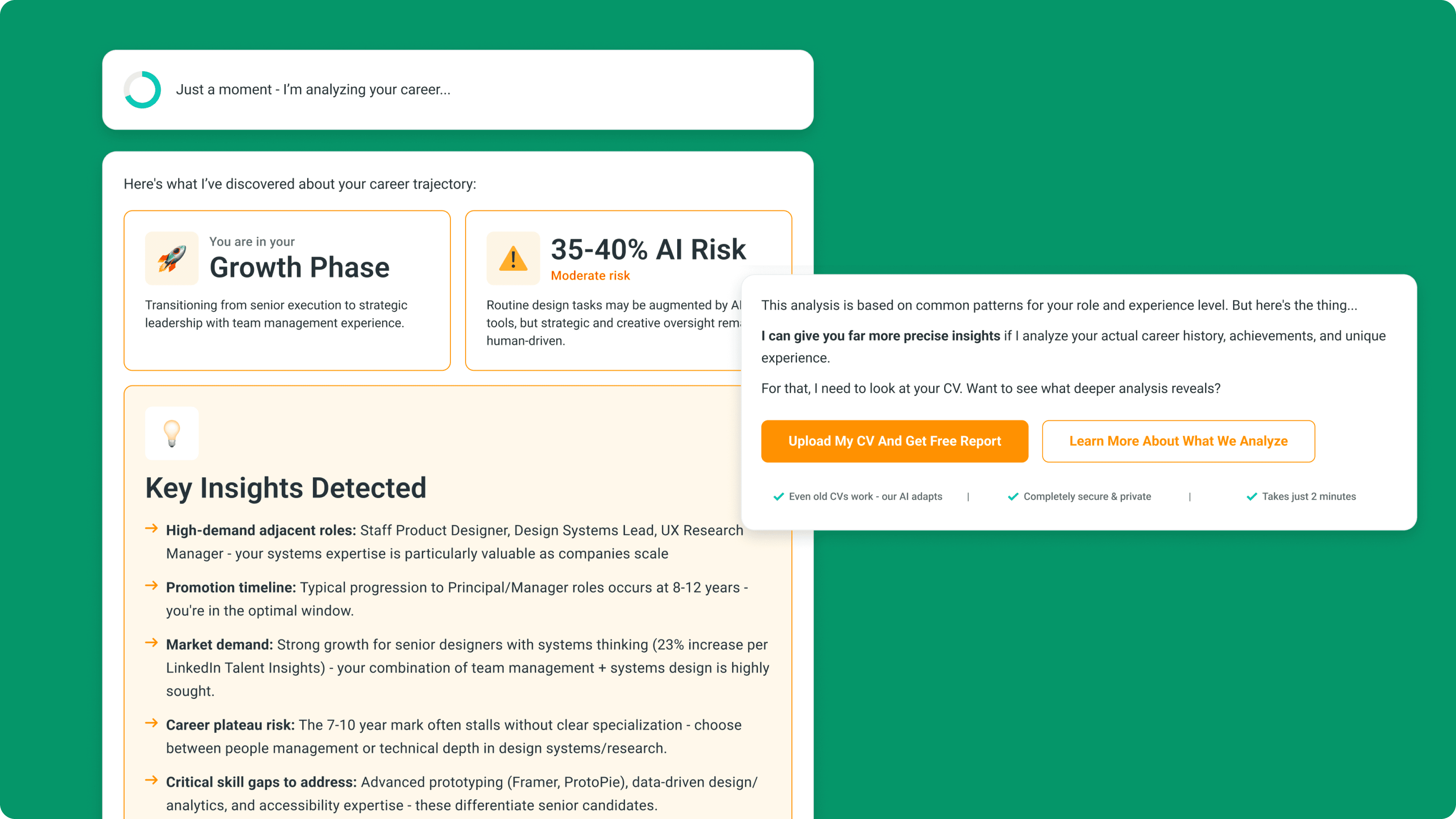
What the preview included:
Career Phase:
"You're in your Growth Phase—transitioning from senior execution to strategic leadership"
AI Risk Assessment:
"35-40% moderate risk—routine tasks may be augmented, but strategic oversight remains human-driven"
Key Insights:
Personalized observations based on their role, experience, and skills, specific enough to feel true, compelling enough to want more
The goal:
Pass the specificity test in 30 seconds. If users see something uniquely true about their situation, trust begins.
Strategic Gating
Show value, don't give it all away.
The balance we struck: Give enough to prove competence, gate enough to create desire for the full report.
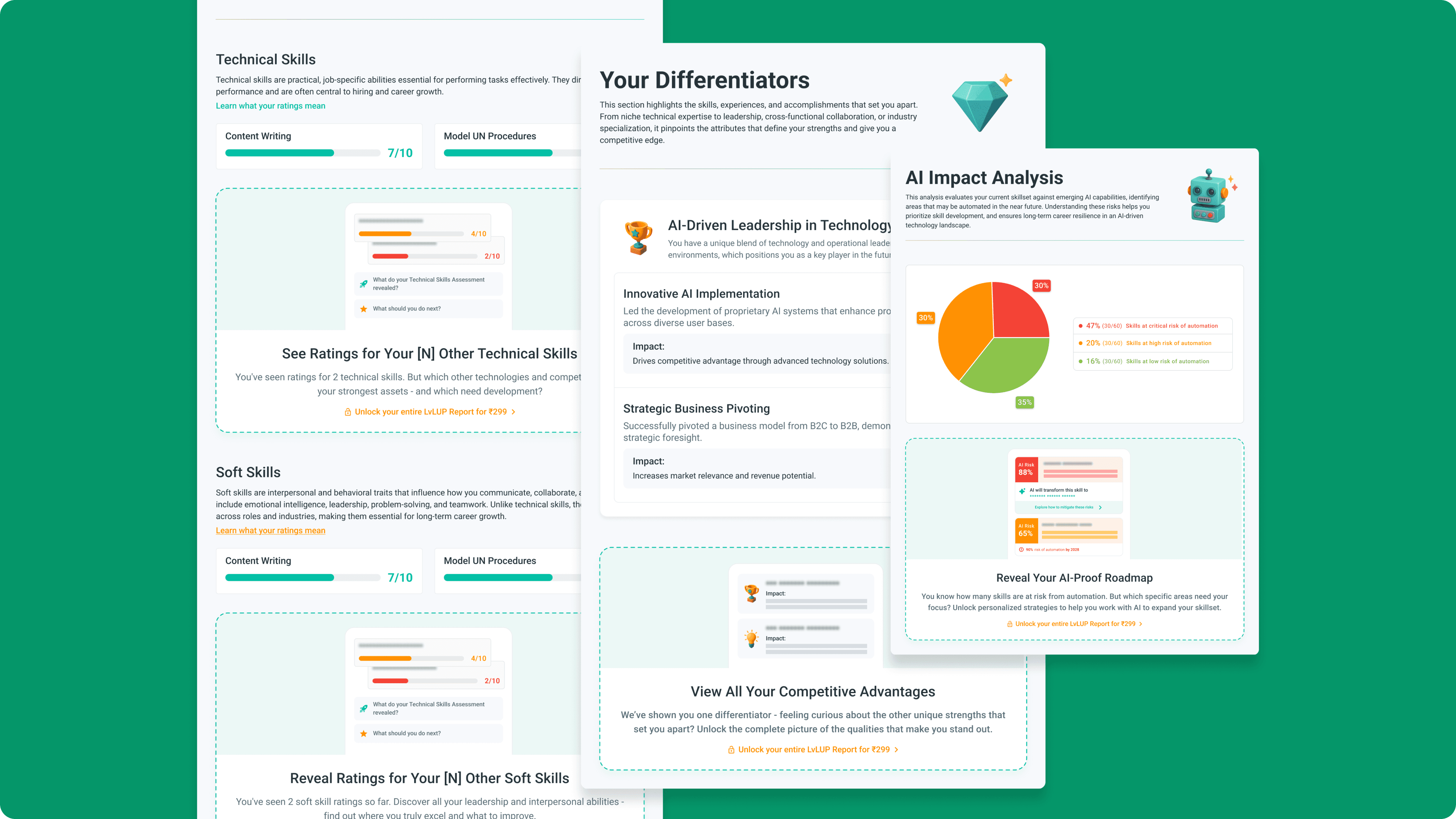
The preview teases depth:
Shows 3-4 high-level insights
References what's unlocked in the full report (specific career tracks, skill gap analysis, 40+ competency ratings)
Creates a "wait, there's more?" moment
The CTA reframe:
"I can give you far more precise insights if I analyze your actual career history, achievements, and unique experience. For that, I need to look at your CV. Want to see what deeper analysis reveals?"
Not "Upload now." But "Want to see what deeper analysis reveals?"
Why this works:
Proves AI competence: Users see the AI "gets them" before committing sensitive data
Demonstrates personalization: Not generic career advice—specific to their inputs
Creates desire for more: The preview is valuable enough to trust, incomplete enough to convert
Reframes the CV request: No longer "give us data," now "unlock what we've already started building for you"
Once the users were convinced, they would have an option to upload their CV and generate their first free report
Testing & Validation
A/B Test: Conversational Flow vs. Upload-First
We couldn't just ship the conversational flow and hope it worked. We needed data to validate whether this trust-building approach actually improved activation.
The test setup:
Control Group | Test Group |
|---|---|
Original upload-first flow | New conversational flow |
"Upload CV → Get Free Report" | "3 Questions → Preview → Upload CV" |
What we measured:
Completion rates, drop-off points, time to first insight, progression through the funnel
What we learned:
The conversational flow reduced hesitation. Users who started answering questions completed at higher rates
Timing mattered, how quickly the AI generated the preview affected drop-off. We worked with engineering to reduce processing time.
The CTA framing shift worked, reframing the ask improved progression to upload

The Results
The conversational flow won
The A/B test results were clear: the conversational trust-building approach significantly outperformed the upload-first flow.
The trust barrier we identified was real. And the conversational approach successfully dismantled it.
Business Impact:
Improved funnel health: Higher progression from landing page → preview → CV upload → full report
Validated the growth strategy: Proved that trust-building UX directly impacts activation metrics
Unlocked future optimization: Now we had a working baseline to iterate from, rather than a broken entry point
Key Learnings
Three principles for designing trust
Trust Precedes Commitment
Users won't share sensitive data with strangers, no matter how clear your value proposition is. You have to earn trust before asking for commitment. Show competence first, request data second.
Progressive Engagement is the Path to Activation
Small ask → demonstrate value → bigger ask. This pattern works because it mirrors how trust builds in human relationships. Conversational UX naturally enables this progression.
Testing Unlocks Truth, Assumptions Don't
We thought the upload-first approach would work because it was efficient. Users thought differently. A/B testing and iteration revealed what actually mattered: psychological comfort over operational efficiency.
Try Lvlup yourself → See the product in action
Want the full story?
This is the compressed version. The complete case study includes:
Detailed user research and psychological barrier analysis
Full conversational flow design specifications
A/B testing methodology and iteration details